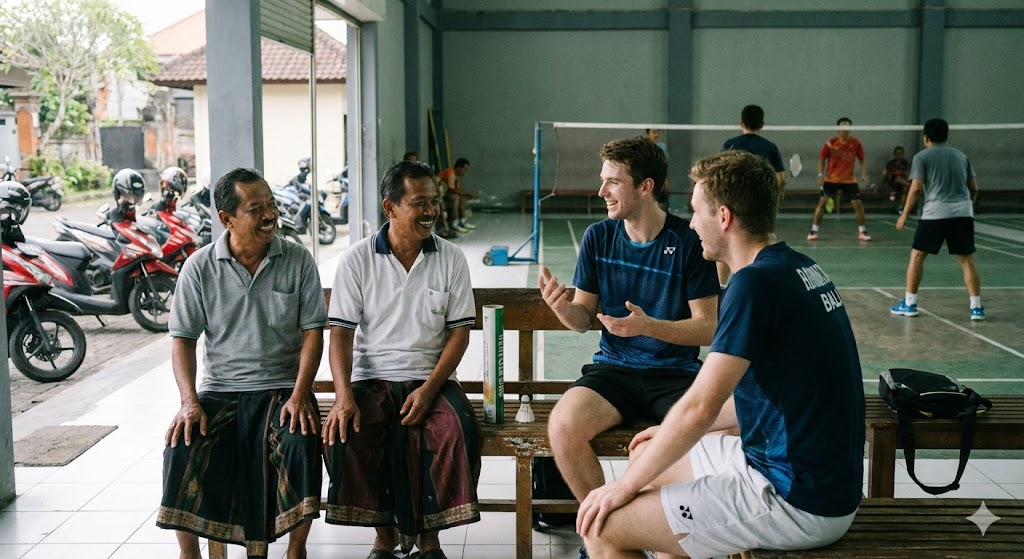
Playing Like a Local: The Essential Guide to Indonesian Badminton Etiquette
In Indonesia, badminton is more than a national sport—it is a shared language. Whether you are playing in a high-end arena in Denpasar or a local community hall (GOR) in a small village, you are stepping into a space with deep-rooted traditions.
For expats and travelers, understanding these “unwritten rules” is the fastest way to earn respect and get invited back to the best games. Coach Anas has trained with and alongside local legends for years; here is his guide to navigating the beautiful social fabric of Indonesian badminton.
1. The Golden Rule: Respect the Equipment (No Feet!)
In Balinese and broader Indonesian culture, the feet are considered the lowest and least “pure” part of the body. Conversely, the equipment used in the national sport is held in high regard.
- The Taboo: Never, ever kick a shuttlecock or use your foot to slide it across the floor to your opponent.
- The Right Way: Always use your racquet to pick up the bird or scoop it toward your partner. Using your feet is seen as a sign of disrespect toward the game and your fellow players.
2. Understanding “Mabar” (Main Bareng)
You will often hear the term “Mabar.” This is short for Main Bareng, which translates to “playing together.” These are organized social sessions where players of varying levels show up to rotate into games.
- The Shuttle “Tax”: In many Mabar sessions, there is a communal tube of shuttles. It is polite to ask the organizer how the shuttle cost is split. Usually, you contribute a small fee or bring a high-quality tube (like Gajah Mada or Yonex) to share.
- The Rotation: Be patient. In a busy GOR, you might play one game and sit out for two. Use this time to socialize—this is where the real “Bali connection” happens.
3. The Net Chord Apology
Badminton is a game of millimeters. If your shot hits the top of the tape and tumbles over for an “impossible to return” point, do not celebrate wildly.
- The Gesture: In Indonesia, it is customary to briefly raise your hand or racquet toward your opponent. It’s a silent way of saying, “Sorry for the luck, that wasn’t pure skill.” It keeps the atmosphere friendly and prevents “panas” (heated) feelings on the court.
4. Respecting Your Elders
In Bali, age carries significant weight. You will often see “Uncles” (Om-Om) in their 50s or 60s playing with incredible touch and deception, even if they aren’t moving as fast as they once did.
- The Greeting: A simple nod or a polite “Halo, Pak” (Hello, Sir) when entering the court area goes a long way.
- The Playstyle: When playing against older locals, focus on consistency and placement. Playing with “ego” or trying to smash every bird at an elder is generally seen as poor form.
5. Movement Between Courts
This is a safety and etiquette rule that is strictly followed in professional Bali arenas.
- The Wait: Never walk behind or beside a court while a rally is in progress. Wait for the point to end, then move quickly. Interrupting a rally to get to your court is the fastest way to annoy the local regulars.
Conclusion: Community First
At its heart, badminton in Bali is about community (Banjar). If you play with a smile, respect the equipment, and follow these local customs, you will find that the local players are some of the most welcoming people on the planet.
Coach Anas specializes in bridging the gap between international players and the local badminton scene. Ready to join a Mabar or level up your game with professional coaching?
Join the Community with Coach Anas | Follow the Journey on Instagram